An Unprecedented Primary Source Archive
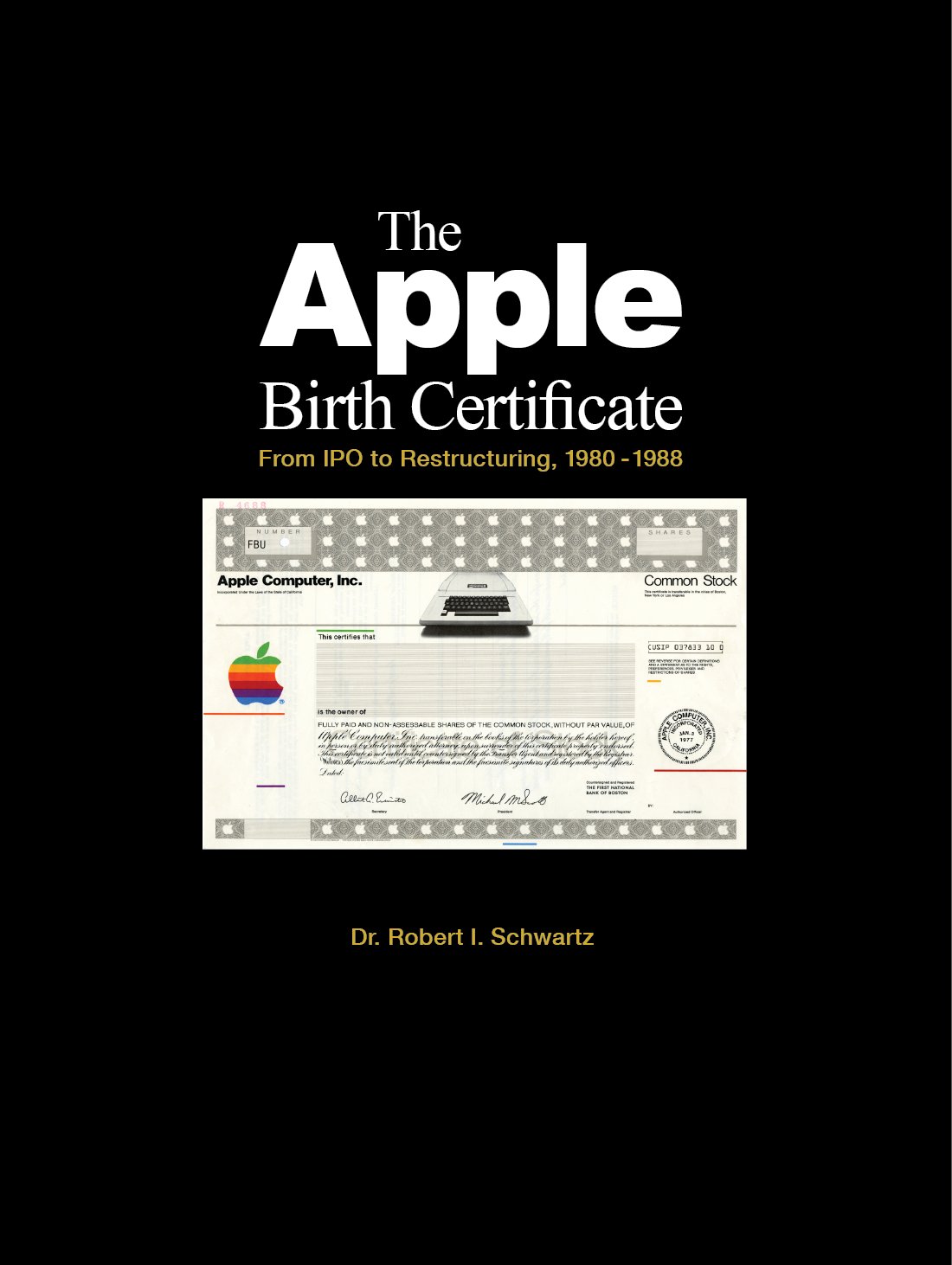
The Apple Birth Certificate book cover
▸  See Inside the Book

The original production archive from the security printing company that produced Apple Computer's IPO stock certificate — 97 artifacts documenting the inside story of that process,
never before published or publicly discussed.

Request Press Copy
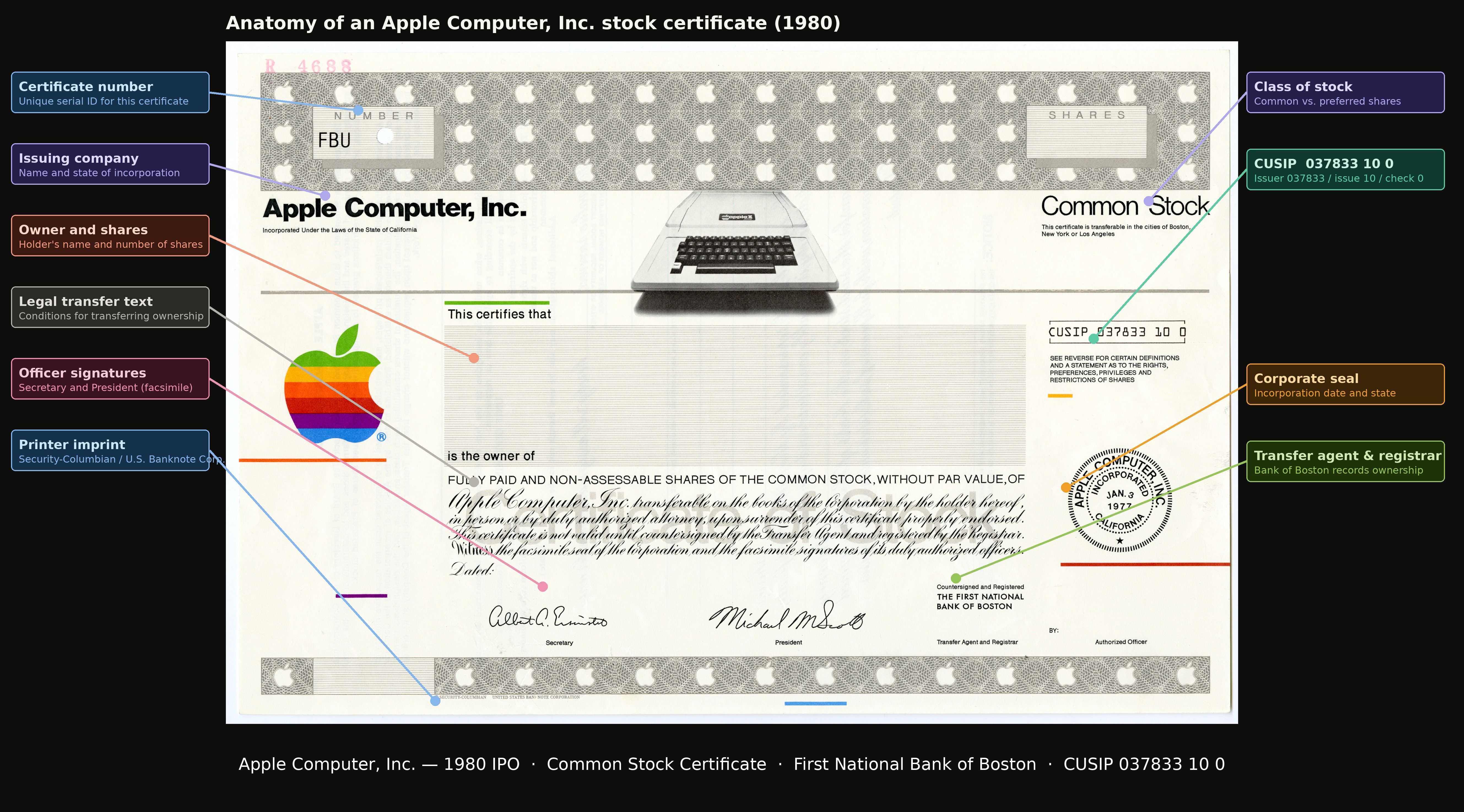
Anatomy of an Apple Computer, Inc. stock certificate, 1980, annotated diagram
97
Original Archive Artifacts
8
Years Documented, 1980–1988
1
Known Complete Archive of Its Kind
From the Production Archive

Artifacts that have never been seen outside the printing plant

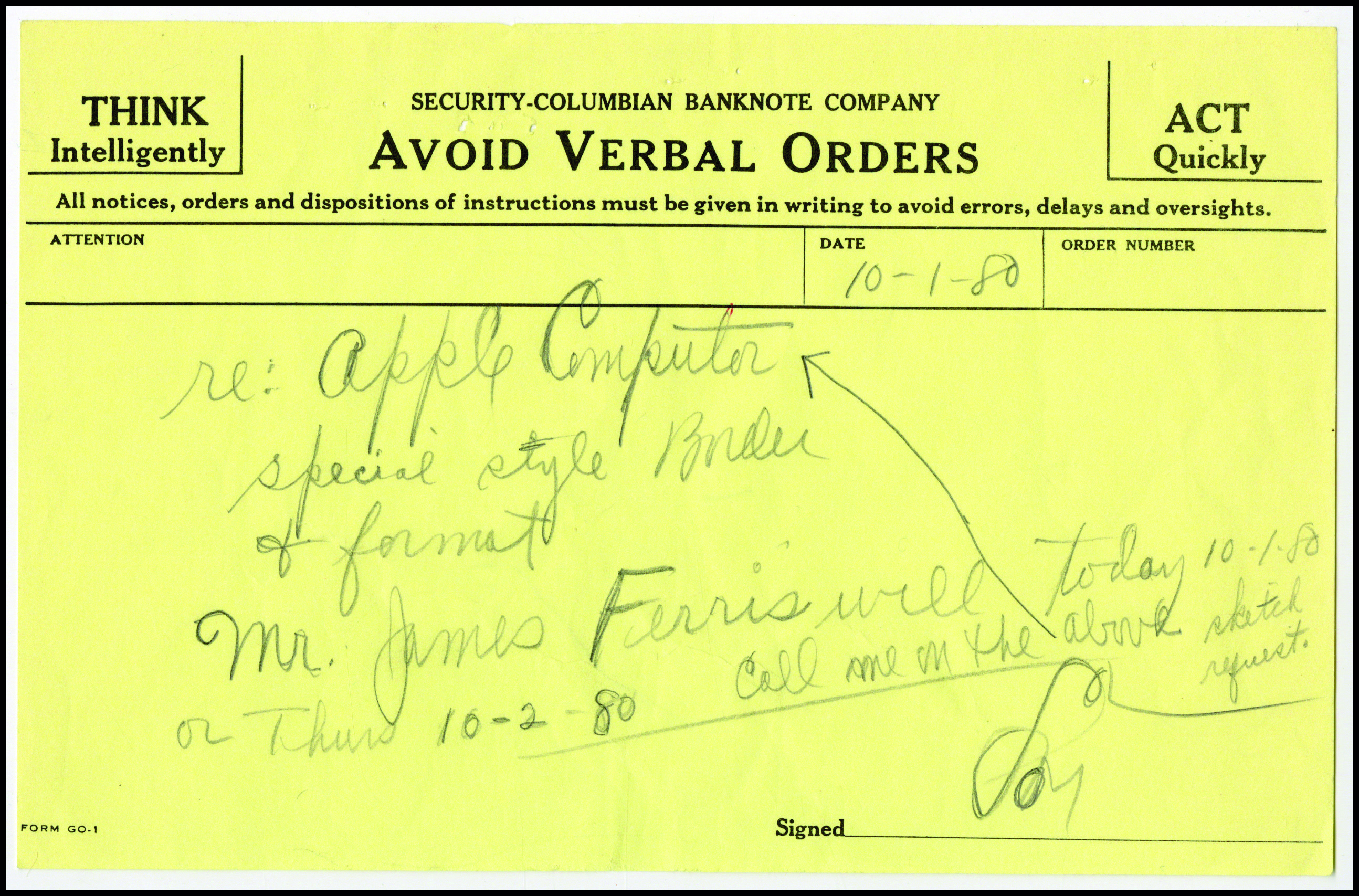
Figure 1
Figure 1 — October 1, 1980
First Internal Memo — re: Apple Computer
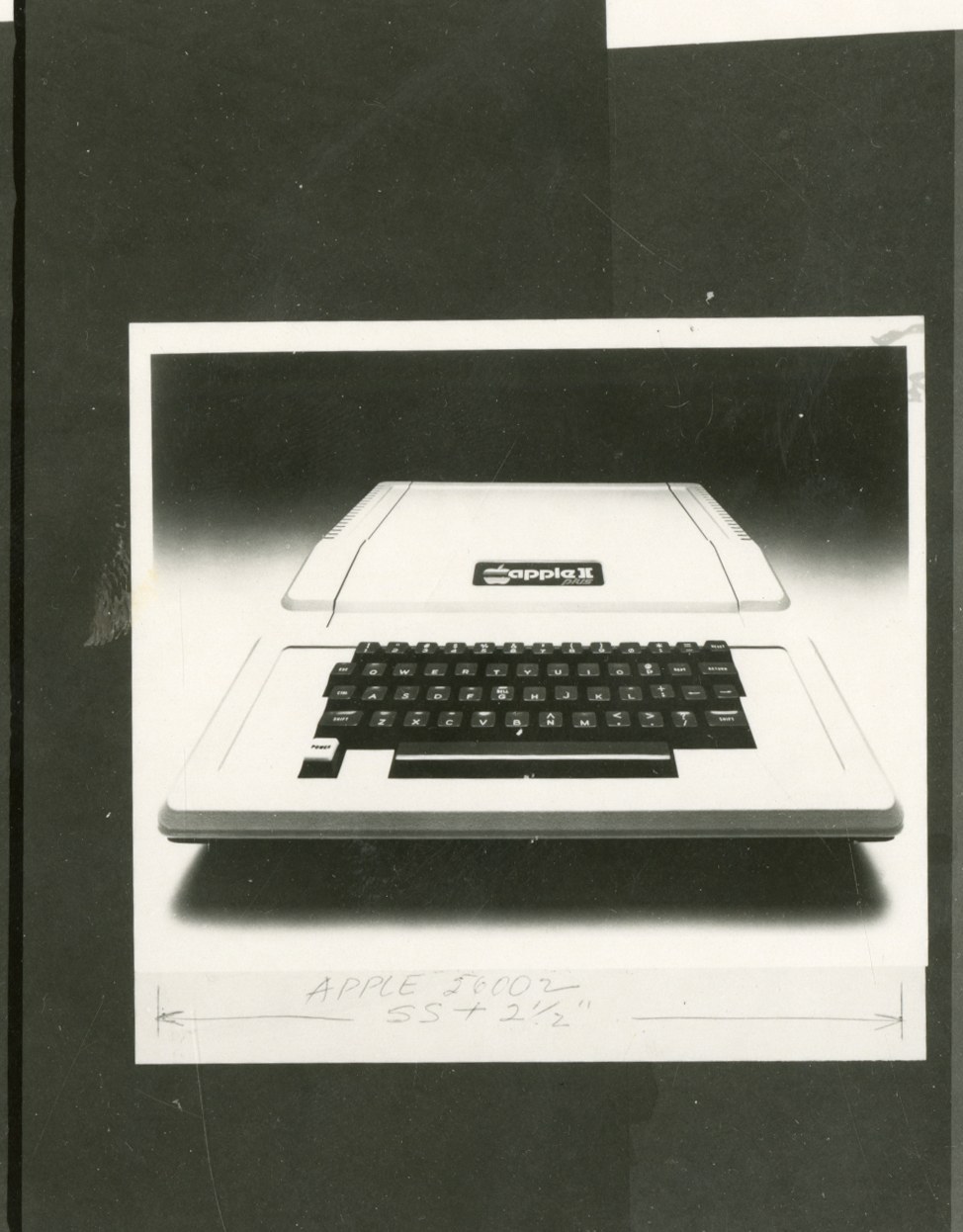
Production photograph
Job BN 56002
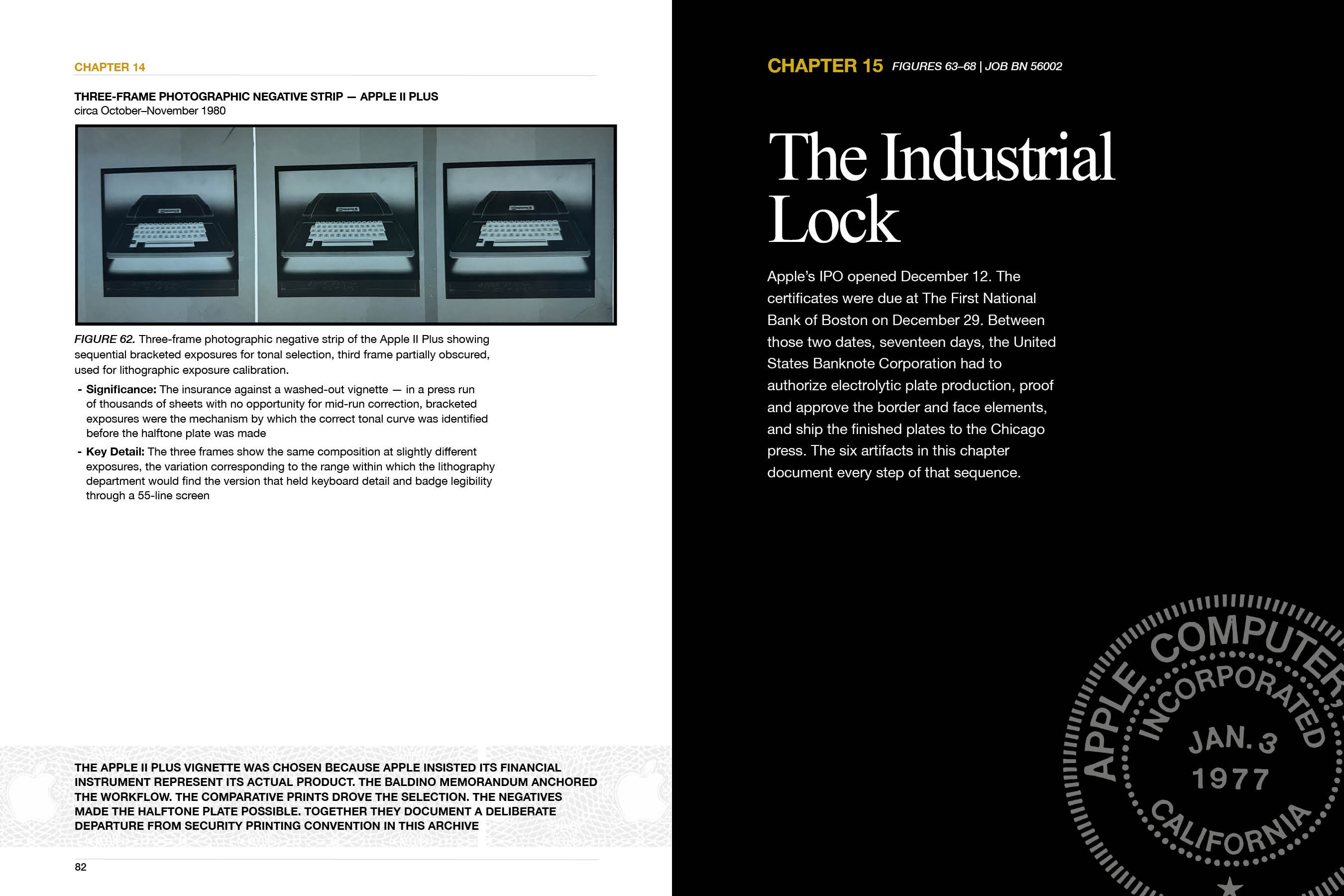
Production Photograph — Apple II Plus
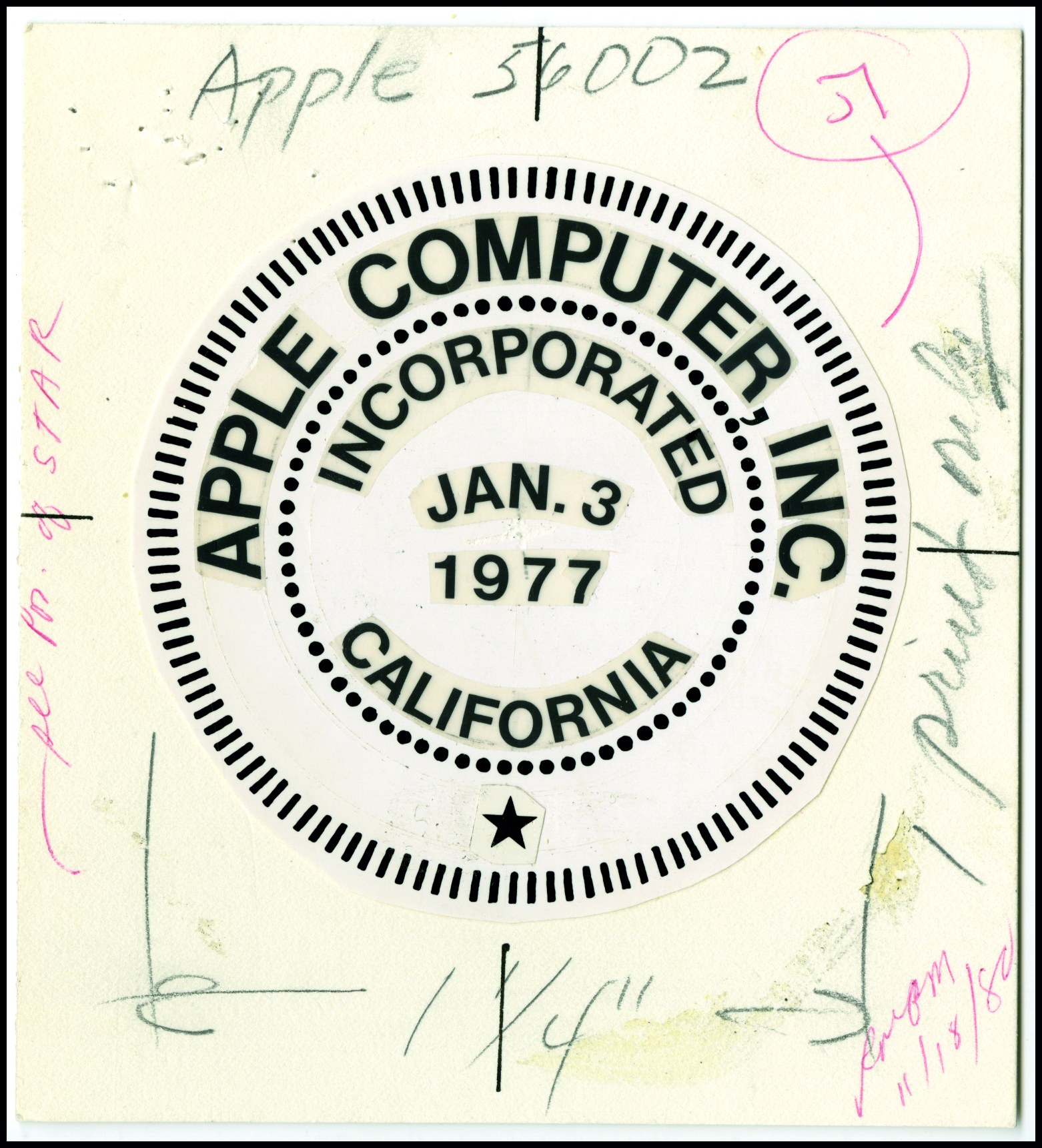
Figure 27
Figure 27 — November 18, 1980
Working Mockup-Pasteup — Apple Corporate Seal
Figure 12
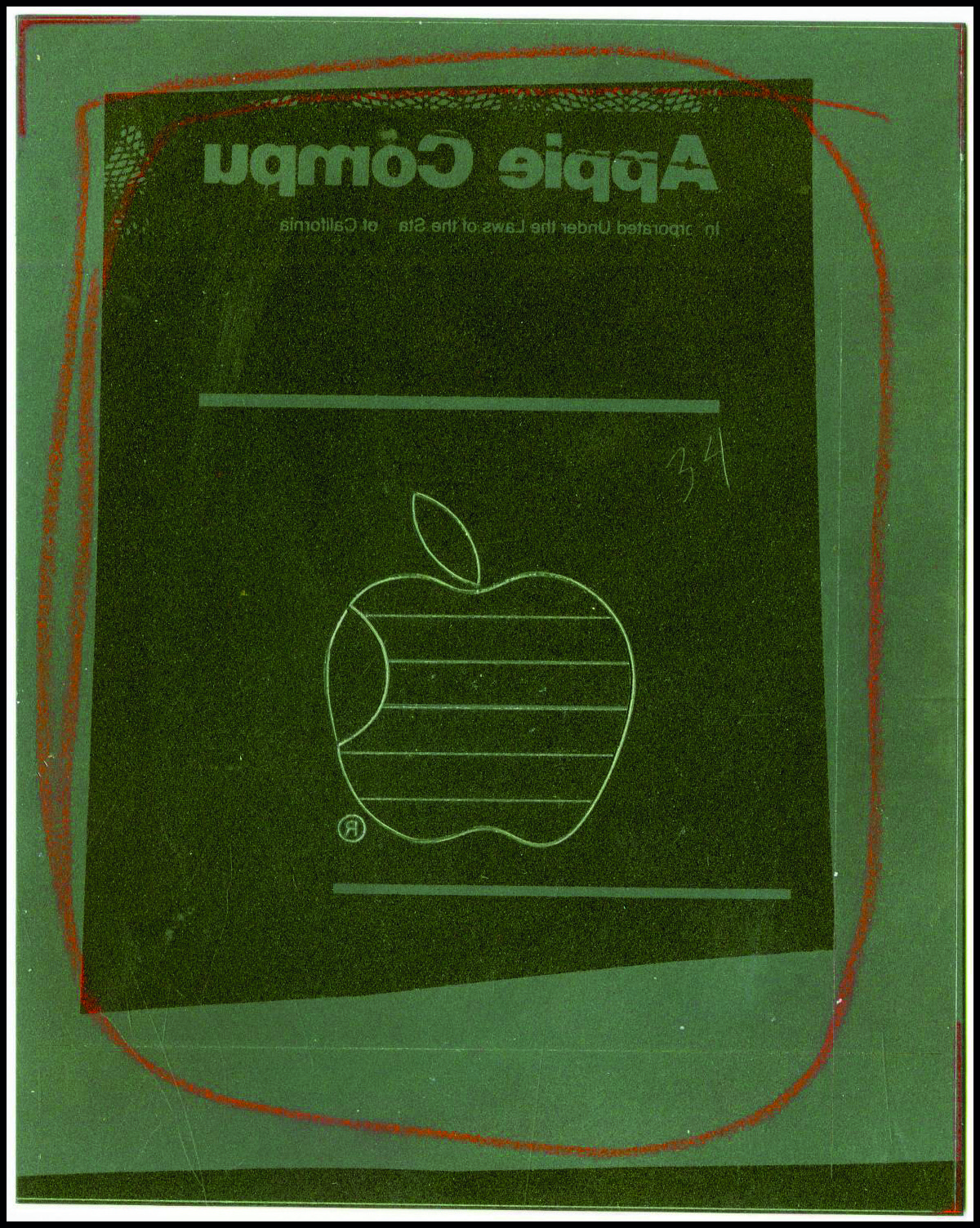
Figure 12 — circa October 1980
Lithographic Negative — Apple Logo Film
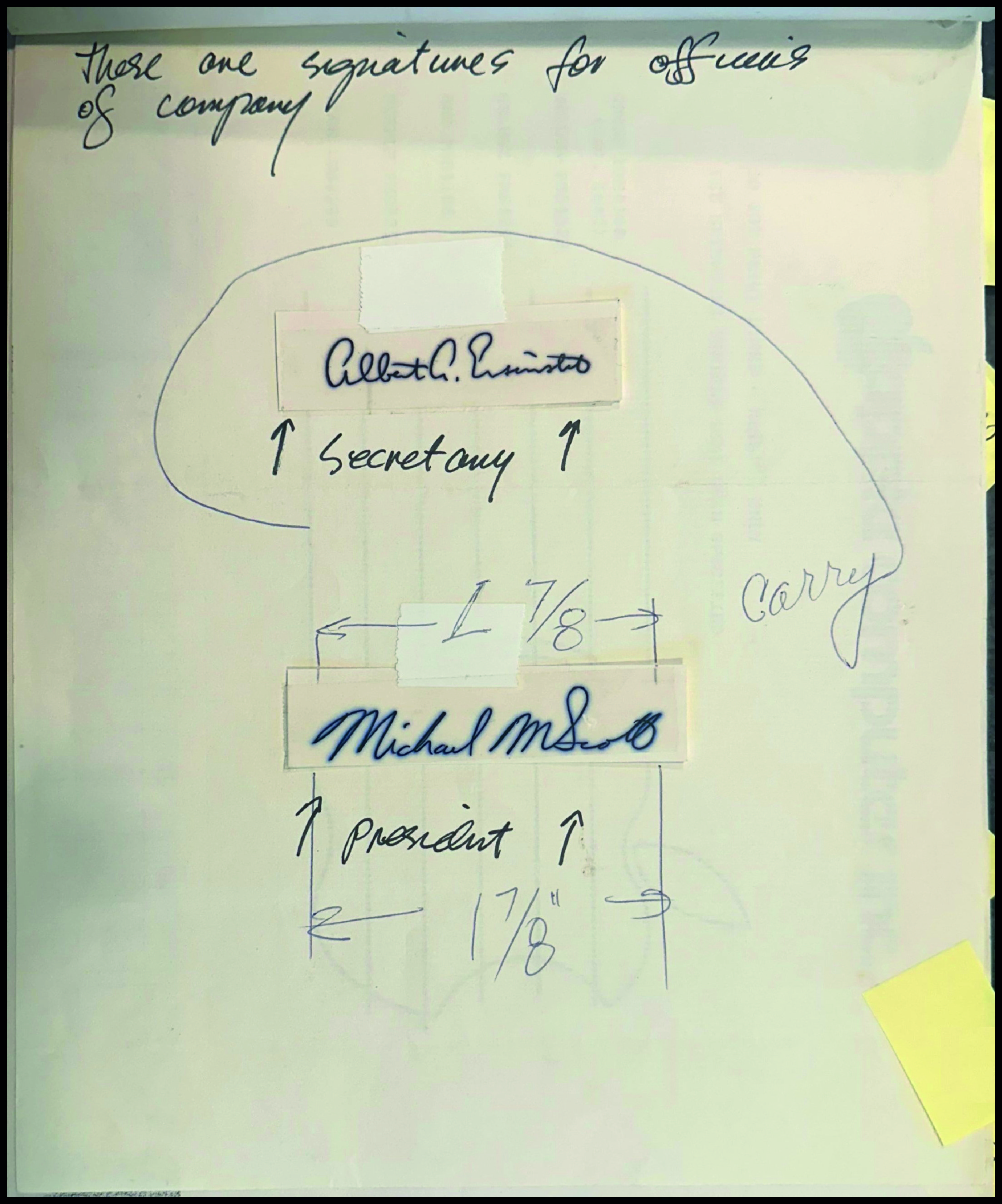
Figure 23
Figure 23 — November 1980
Officer Signatures — Eisenstat & Scott
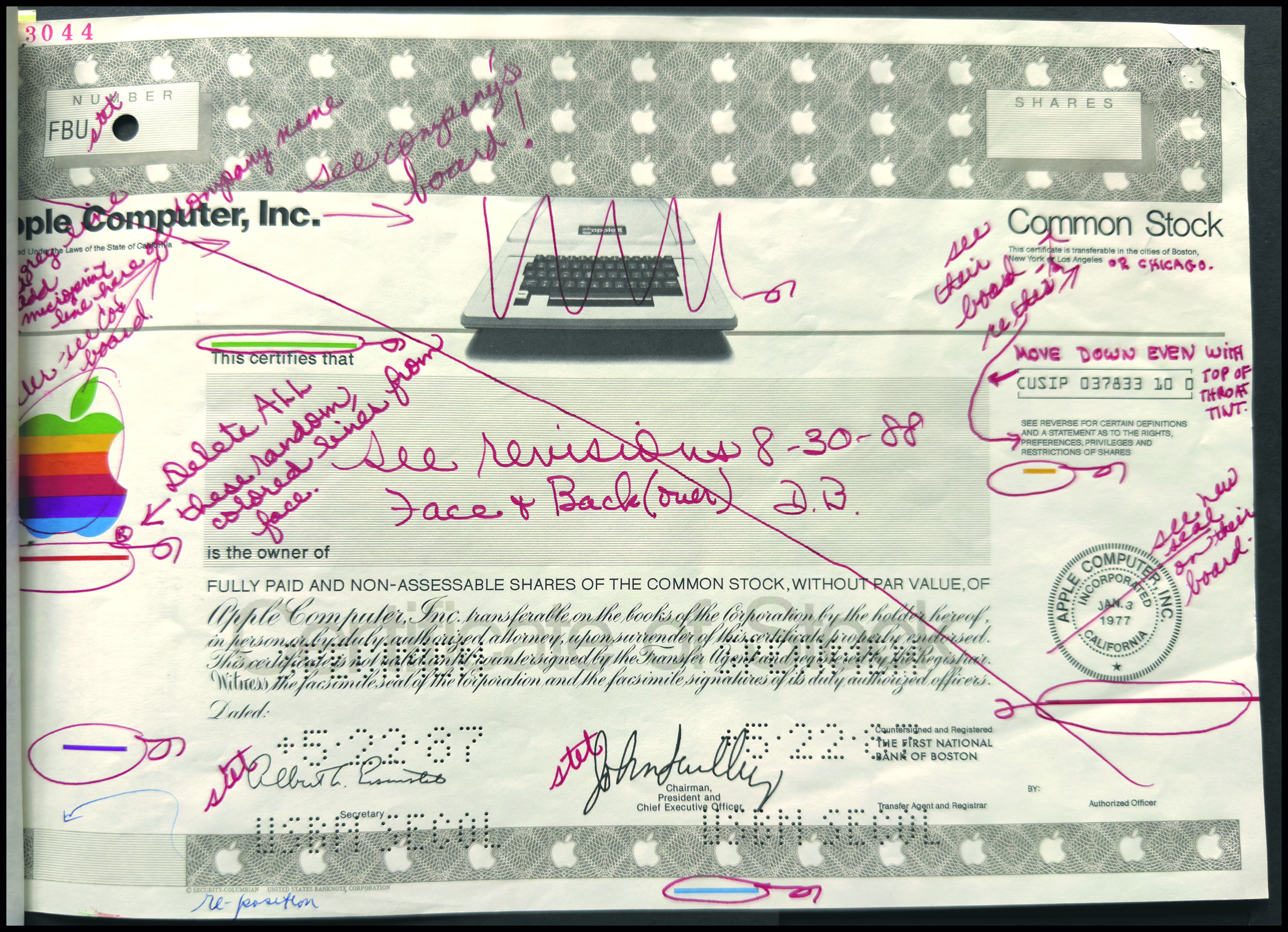
Figure 72
Figure 72 — August 30, 1988
Annotated Proof — 1988 Redesign Revisions
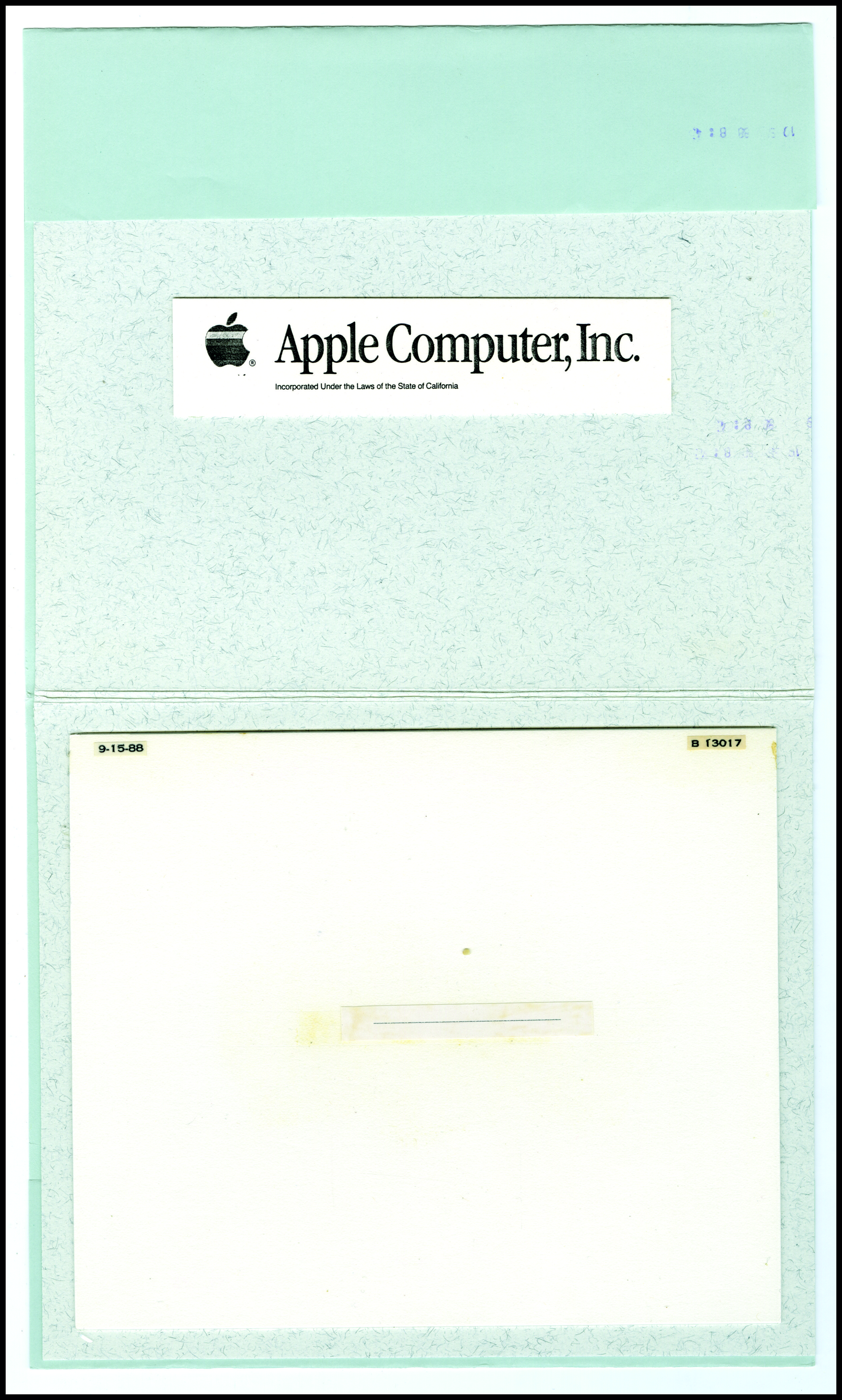
Figure 81
🔍
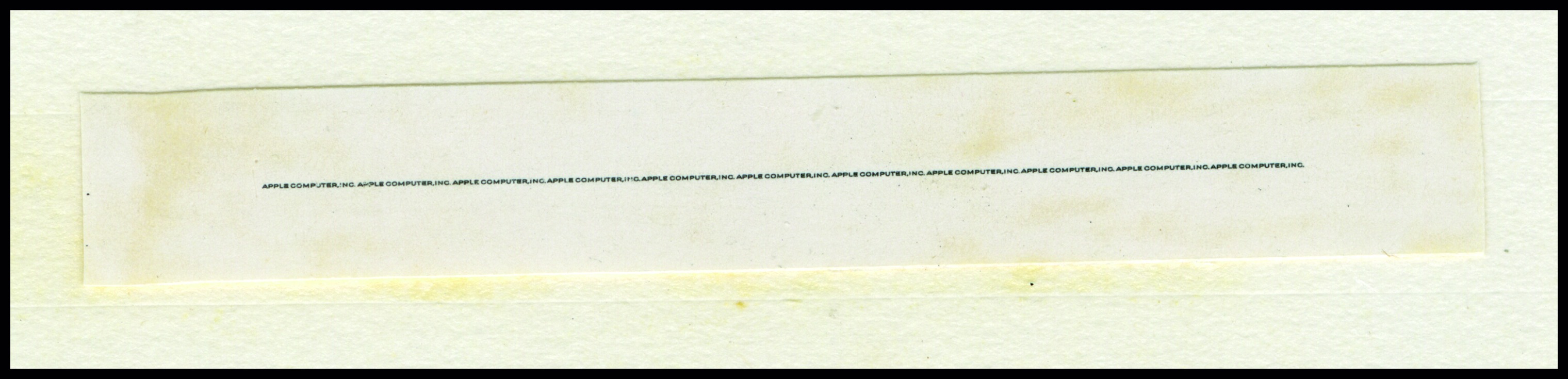
Microprint strip detail
Microprint strip magnified
Figure 81 — September 1988
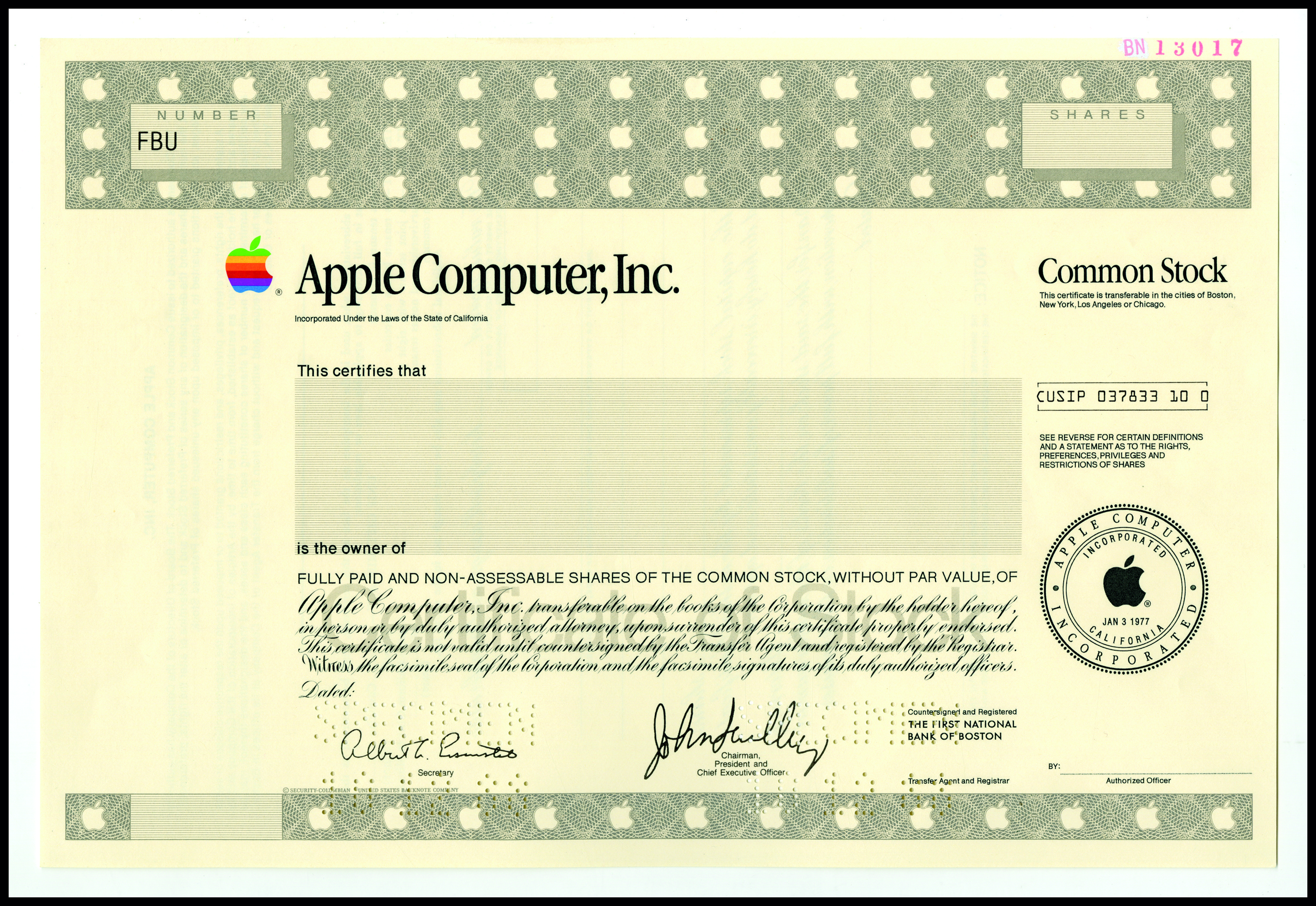
Security Paper Sample — Job B 13017
Figure 97
Figure 97 — 1988 Issue
Final Issued Certificate — BN 13017
Preview

See Inside the Book

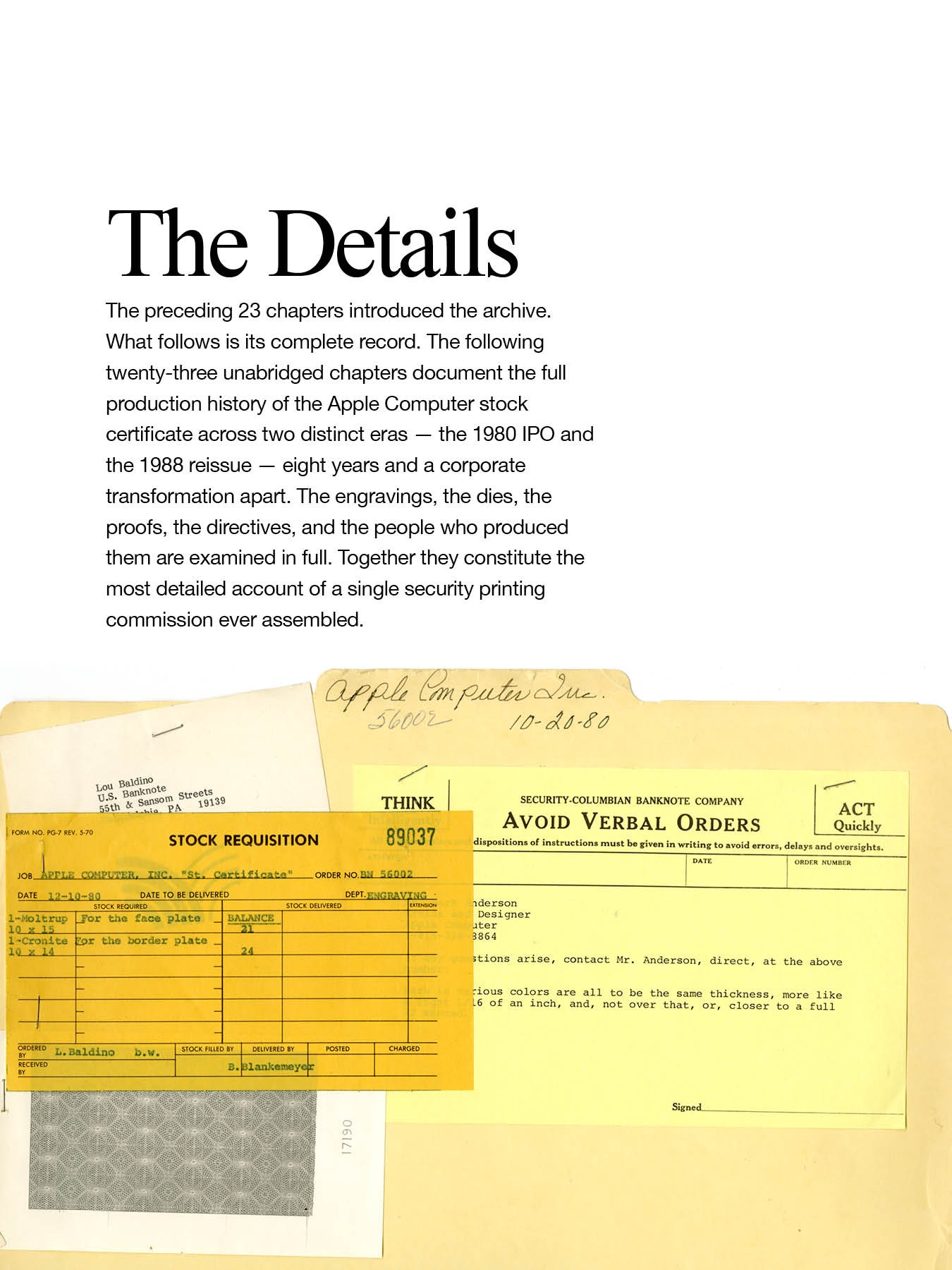
The Details
The Details
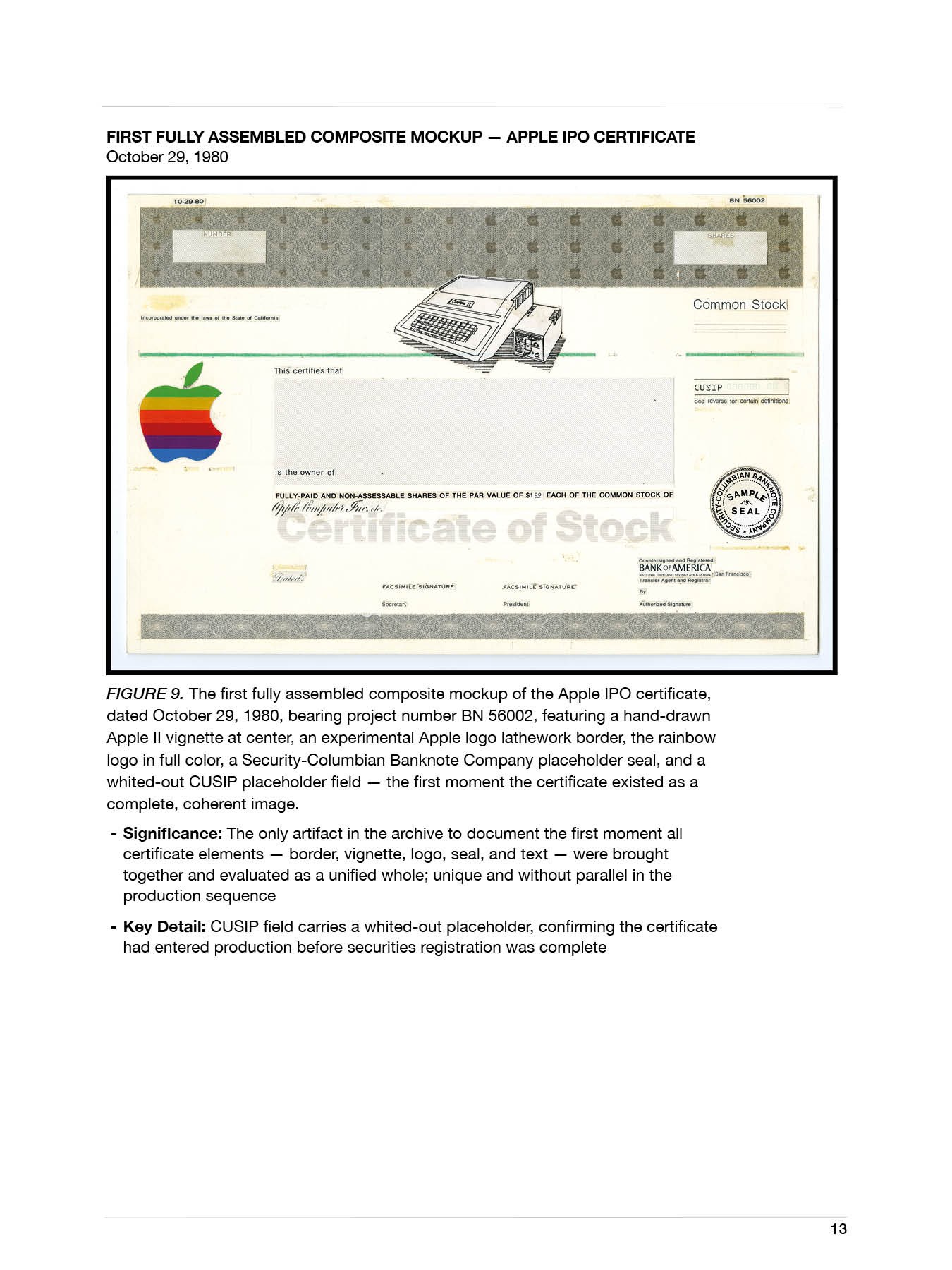
Figure 9
Figure 9 — October 29, 1980
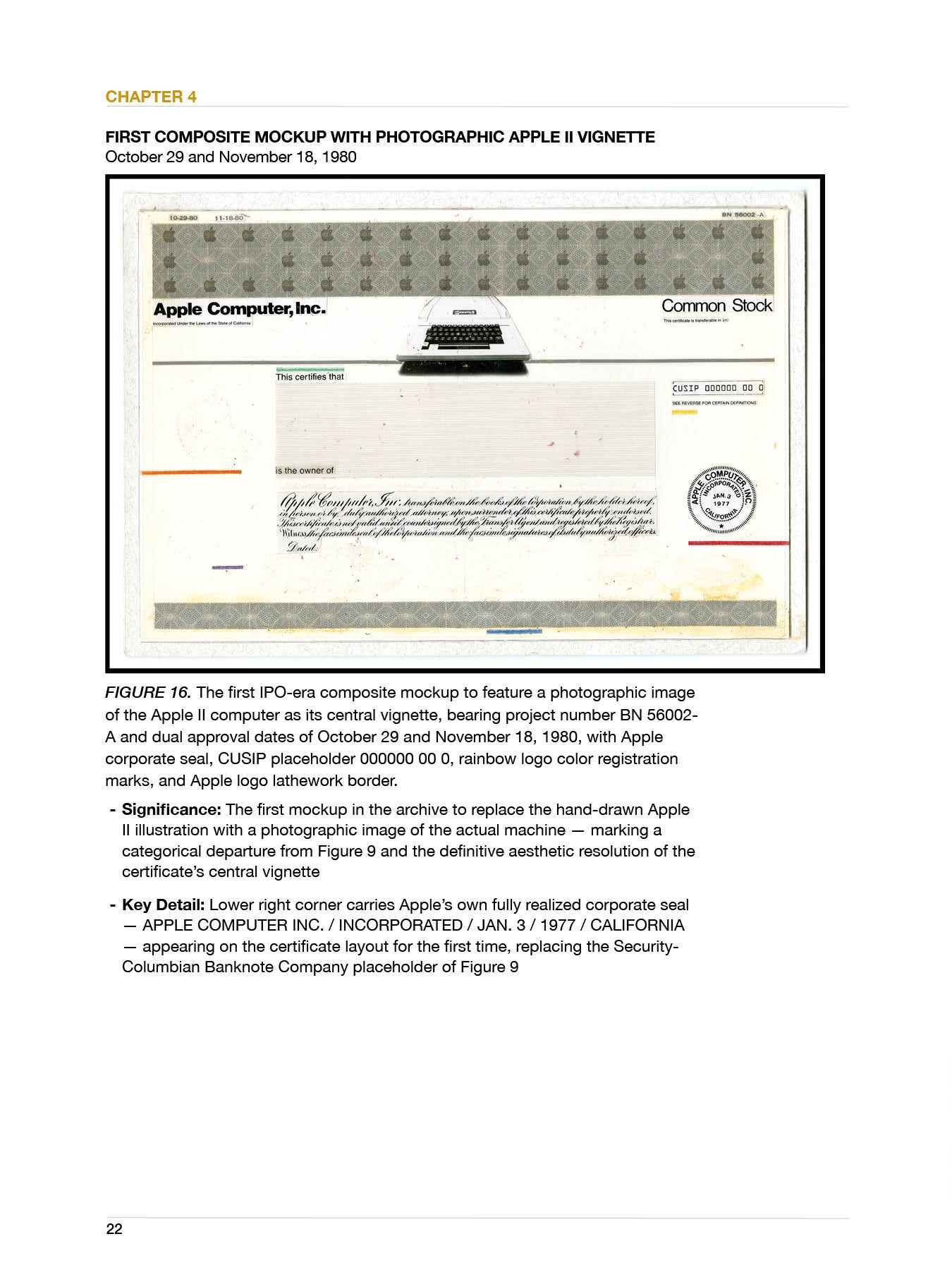
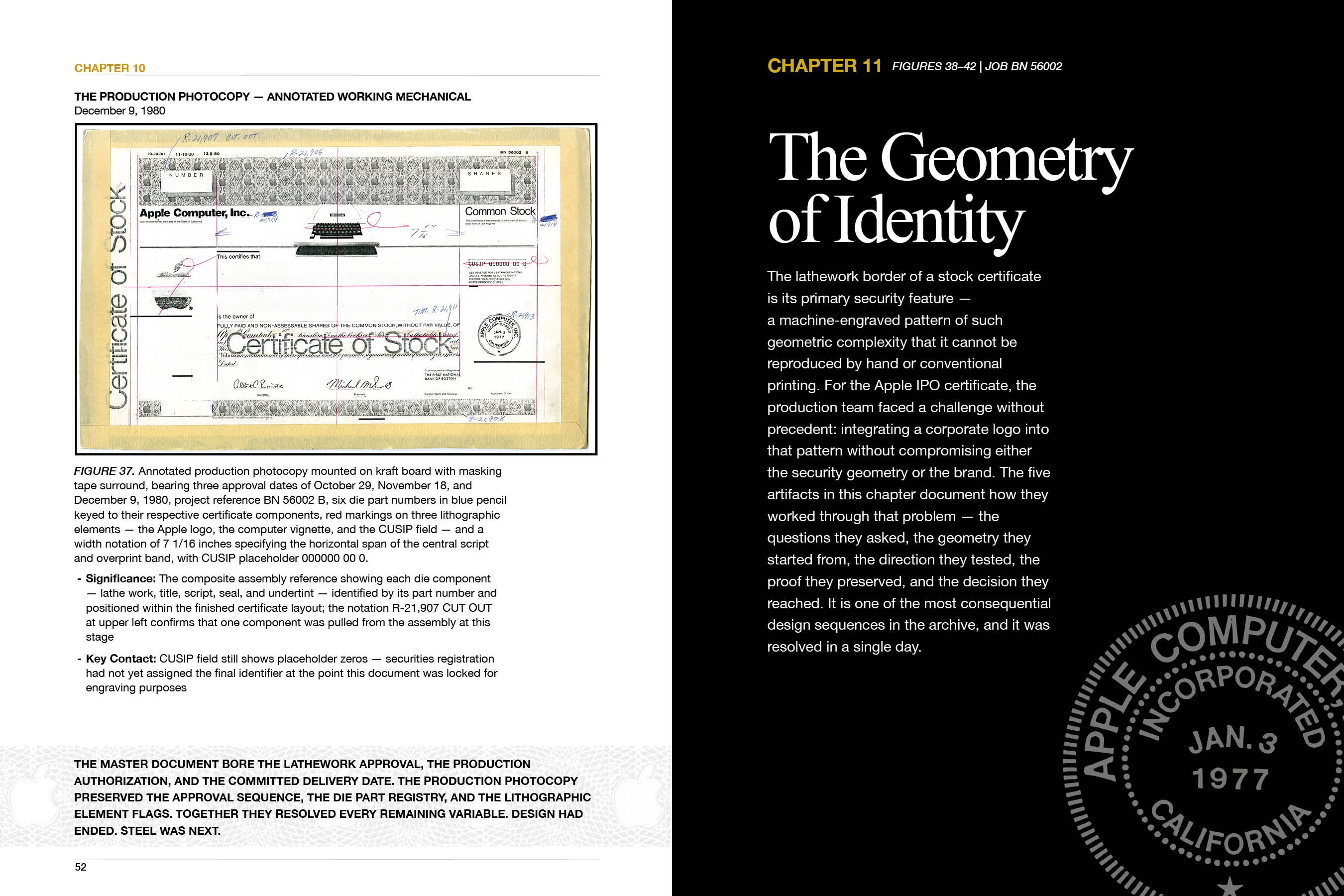
Figure 16
Figure 16 — November 18, 1980
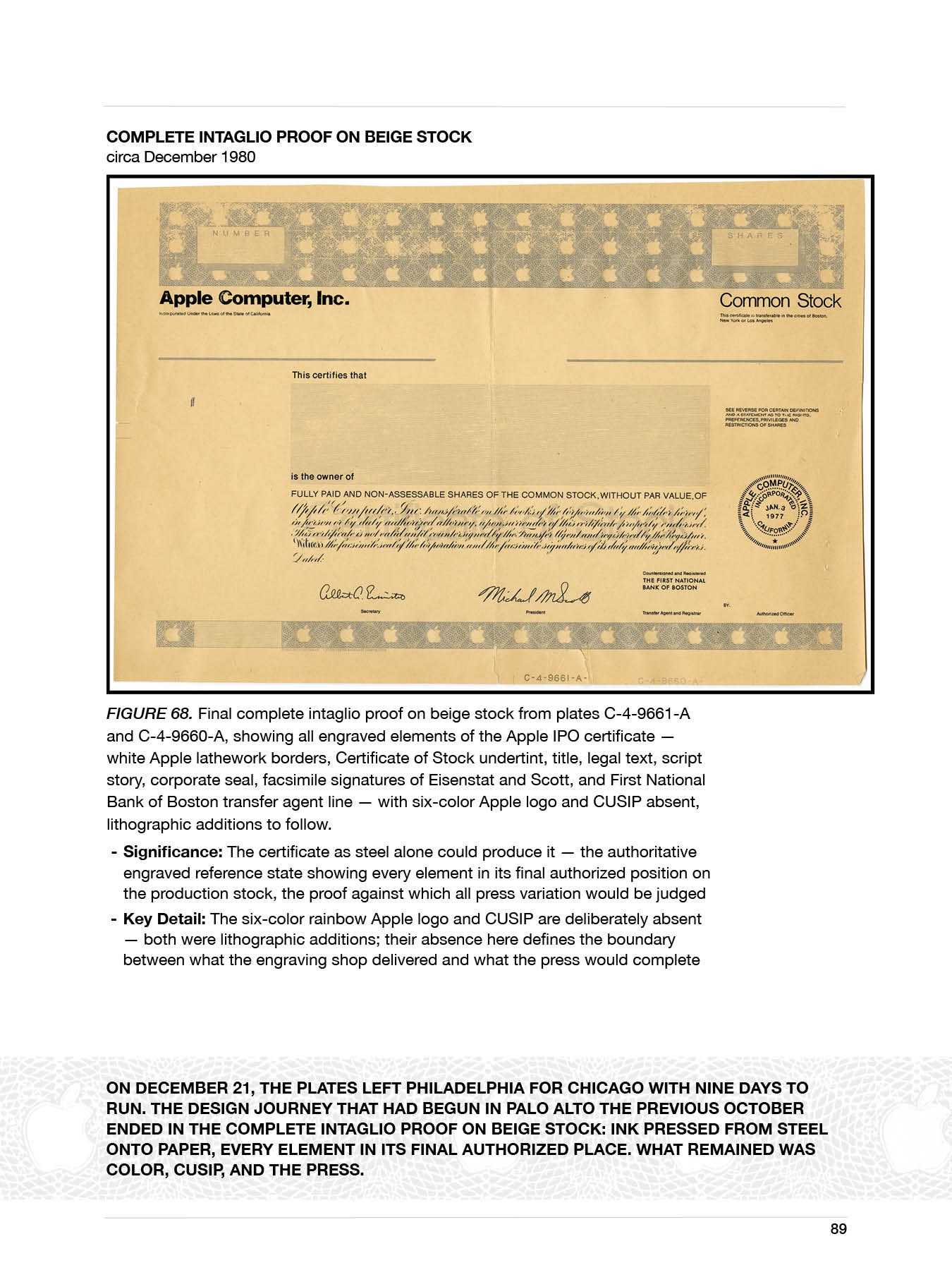
Figure 68
Figure 68 — December 1980
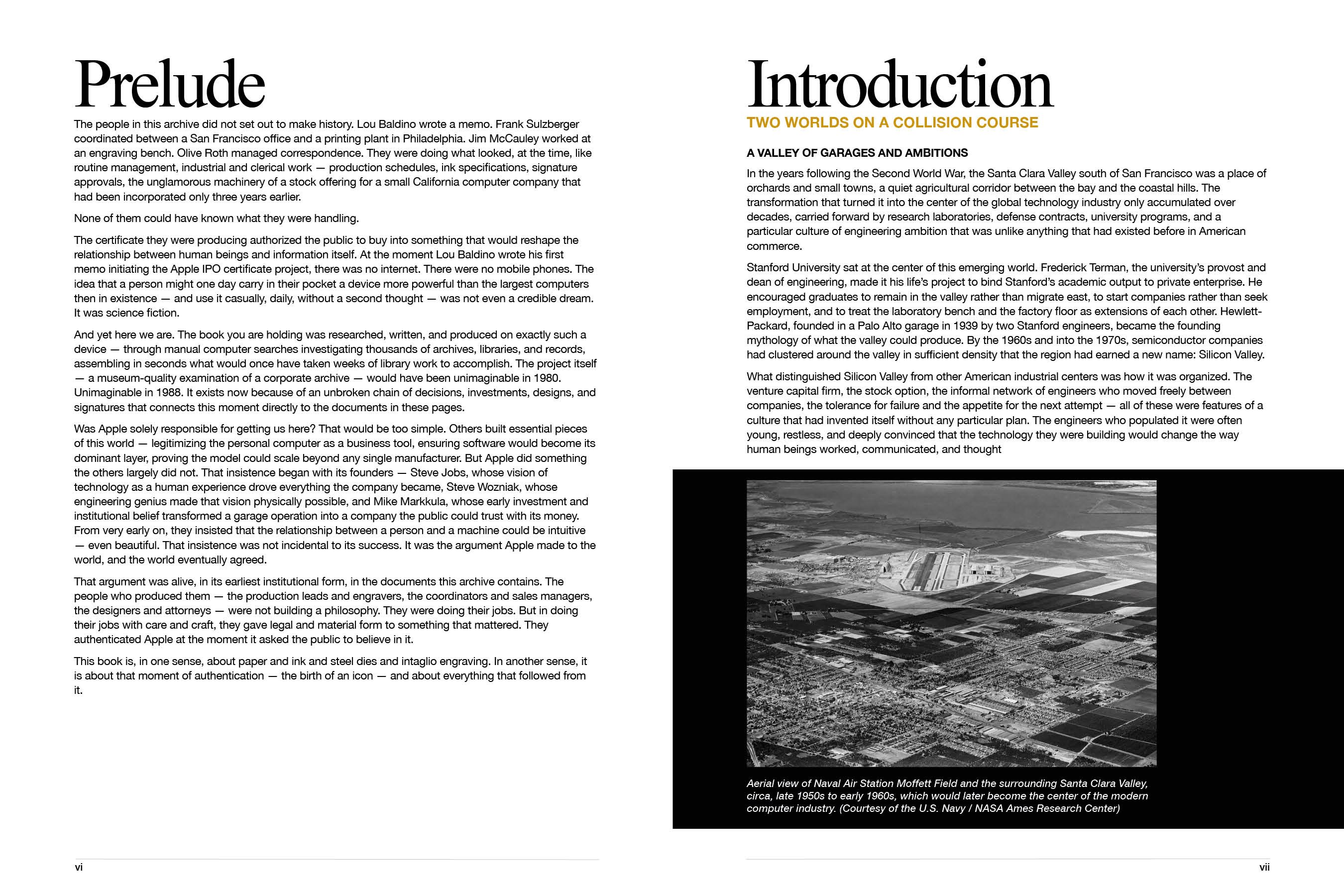
Prelude and Introduction
Prelude & Introduction
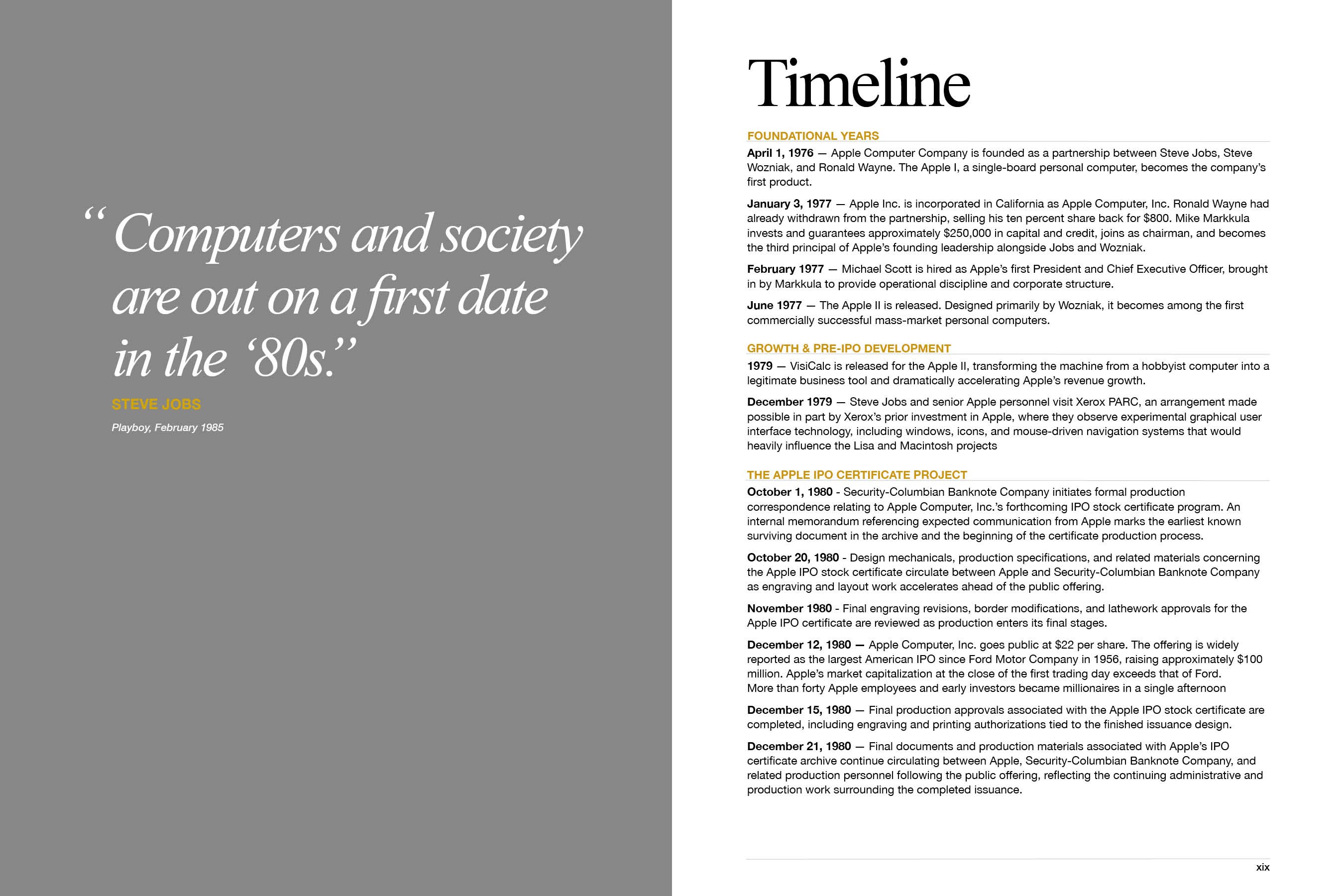
Timeline
Timeline
The Geometry of Identity
Chapters 10-11: The Geometry of Identity
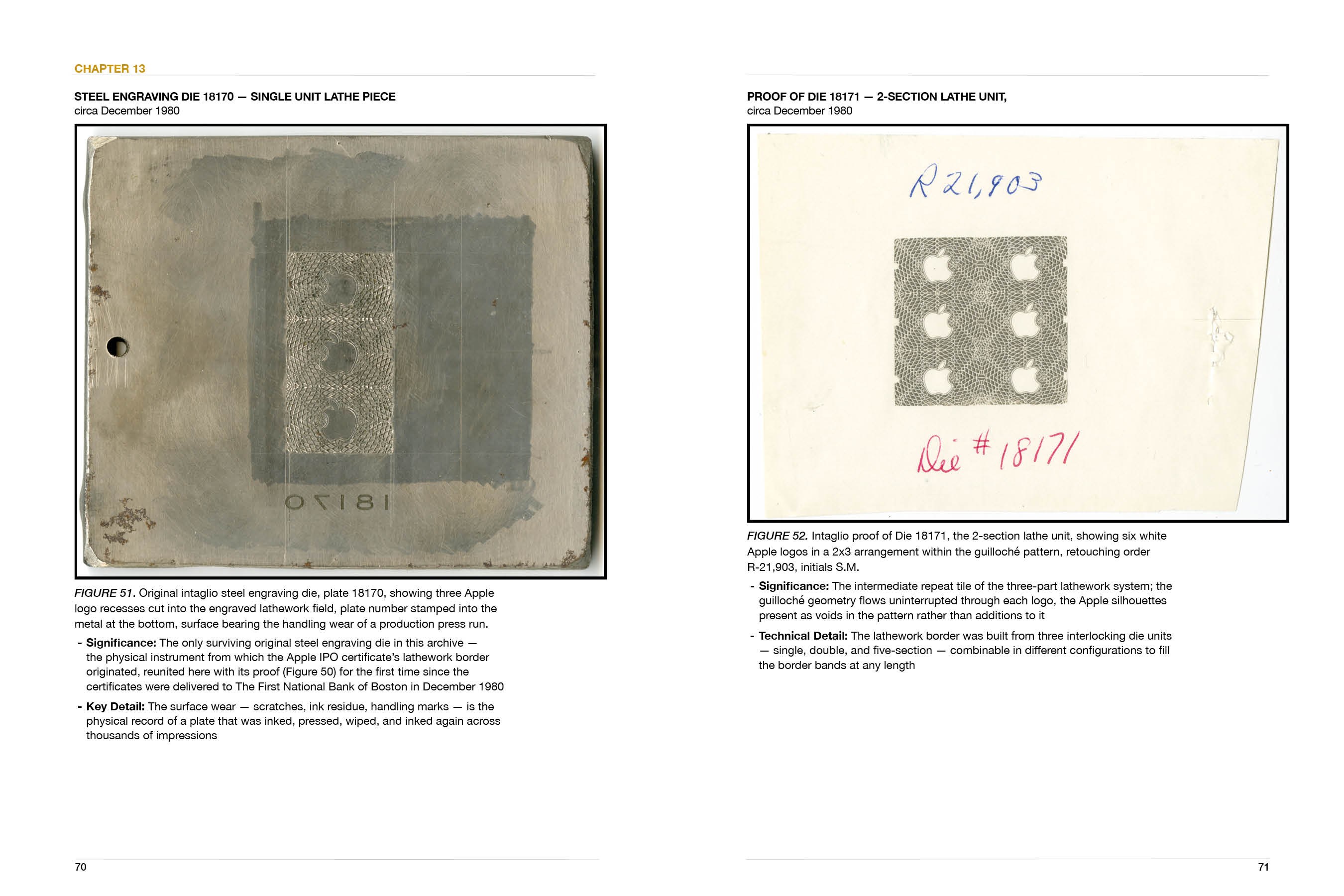
Steel Engraving Dies
Chapter 13: Steel Engraving Dies
The Industrial Lock
Chapters 14-15: The Industrial Lock
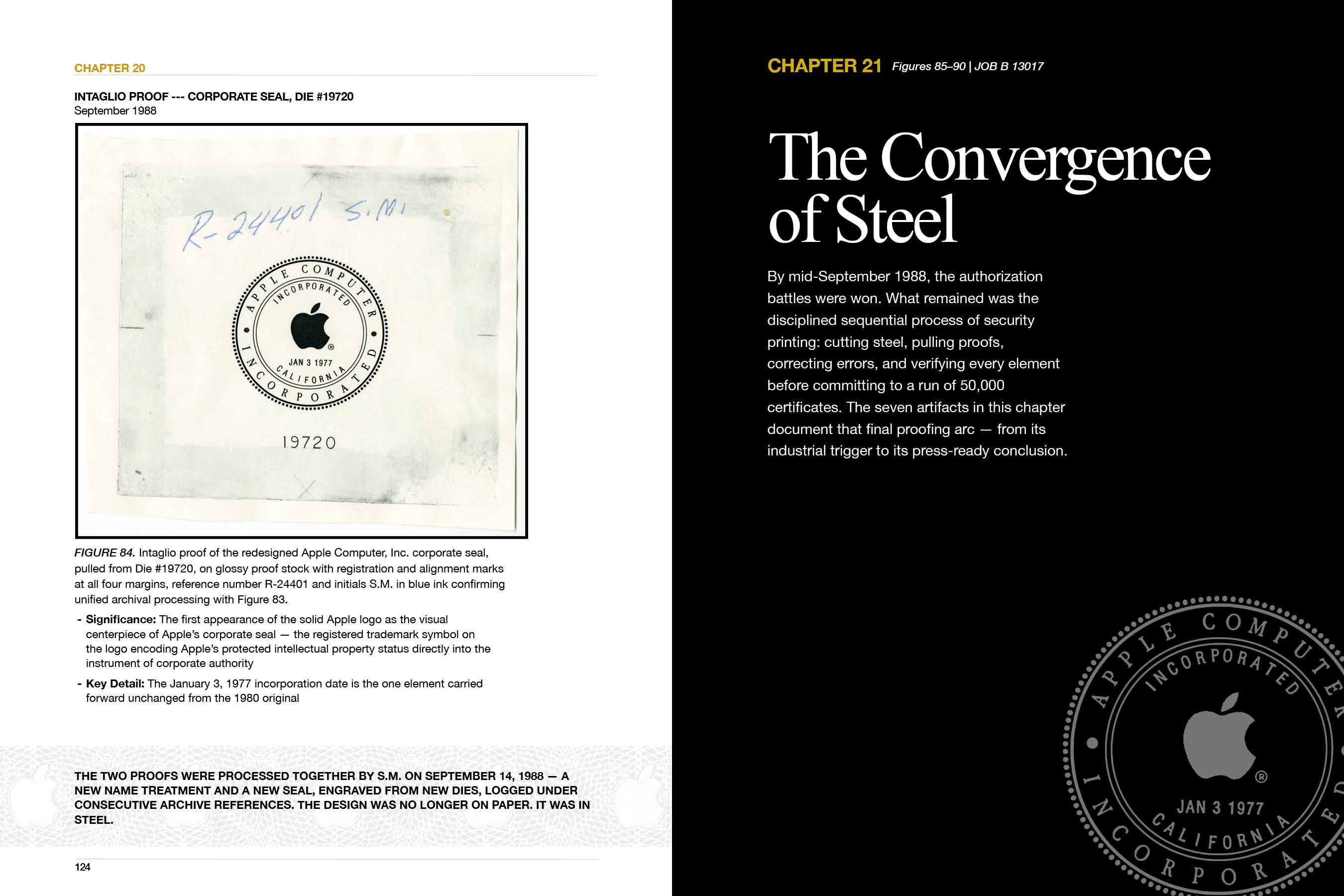
The Convergence of Steel
Chapters 20-21: The Convergence of Steel

A forensic account of how Apple went public

When Apple Computer, Inc. filed for its initial public offering in December 1980, the shares it issued had to be represented by physical stock certificates — security instruments produced by engravers, printers, and craftsmen operating in a world entirely unlike Silicon Valley.

The production archive documented in this book captures that process from the inside: the job orders, the working proofs, the corrections, the rejections, and the final authorizations that turned a blank sheet of security paper into the legal instrument of Apple's public birth.

Nothing in this archive has been published before. Nothing has been discussed publicly. It exists because one printing company kept its files, and because those files survived.

Dr. Robert I. Schwartz · Archives International LLC
Press & Media

Author
Dr. Robert I. Schwartz
Subject
Apple Computer IPO, security printing, corporate history
Archive Held By
Archives International LLC
Contact
robert@archivesinternational.com
Request a Press Copy
Why It Matters

Everyone studied the founders. No one studied the paper.

The Apple IPO is one of the most documented events in business history — and yet the engraved certificate at the center of it has gone unexamined for nearly fifty years. What follows is the story behind that paper: how it was made, who made it, why it mattered, and what it reveals about the morning a garage company rewrote the rules of Wall Street.

The Numbers That Made History
$22
Opening price per share, December 12, 1980
4.6M
Shares offered to the public
$1.8B
Valuation by the end of day one
300+
New millionaires created overnight
1956
Ford's IPO — the last one larger than Apple's
Why 1980 Was Different

The Apple IPO didn't just make money — it changed the template. It proved a young technology company with no industrial history could command a valuation rivaling America's industrial giants, and signaled to Wall Street that Silicon Valley was the future. Every tech IPO that followed traced its logic back to the morning Apple went public.

The Story Behind the Paper

A four-year-old garage company, made public on a single engraved page. The world remembers the event. This archive is about the object it happened on.

How a Stock Certificate Is Born
  1. 01DesignThe layout, borders, and vignette are drafted to corporate and regulatory specification.
  2. 02EngravingMaster craftsmen cut the image into steel plates by hand, line by line.
  3. 03ProofingTrial impressions are pulled, flagged, and corrected — sometimes across dozens of rounds.
  4. 04ApprovalThe issuing bank and the company's corporate secretary sign off on every element.
  5. 05PrintingCertificates are run, numbered, and secured under strict controls.
  6. 06IssuanceOnly then can a share legally change hands. The 97 artifacts here are the surviving evidence of steps one through five.
The Bank Behind the Paper

The certificate carries the name of the First National Bank of Boston, Apple's transfer agent — the institution responsible for recording ownership, preventing fraud, and honoring transfers. The archive's correspondence reveals a century-old Boston bank and a four-year-old California computer company meeting on a single engraved page.

What a CUSIP Tells You

Stamped on the certificate is a nine-character code: CUSIP 037833 10 0 — the certificate's fingerprint, a unique identifier assigned to every publicly traded security in North America. Apple's has remained part of its identity for nearly five decades, a quiet thread connecting the 1980 paper to the shares traded electronically today.

Why Paper Mattered

In 1980, owning Apple stock meant holding it. The certificate was the legal embodiment of ownership — not a database entry, but an engraved object you could lock in a vault. Lose it, and you lost your claim. This was wealth made tangible.

The Last Generation of Paper

Apple went public at the close of an era. Within two decades, paper certificates would vanish into electronic book-entry systems. The 1980 certificate belongs to the final chapter of a 400-year-old tradition — engraved finance, soon to be obsolete.

Scripophily: Collecting Financial History

There's a name for collecting old stock and bond certificates — scripophily — and Apple's is among the most coveted. Surviving original 1980 certificates are rare; the production materials behind them are rarer still. This archive isn't a single collectible. It's the workshop where the collectible was made.

The Story Historians Missed

Decades of Apple history have focused on founders and products. None examined the financial instrument at the center of the company's transformation, or the printing plant that produced it. This archive opens a primary source unexamined for nearly fifty years — and reframes a familiar story through an object everyone overlooked.